Originally appeared in the August 2020 Rotarian managine.
By Geoffrey Johnson Illustrations by Sjoerd Van Leeuwen
These clubs keep things fresh with
new ideas and new members
What is Rotary? It’s a whole community of people who are members of Rotary and Rotaract clubs, of course, but it’s also people who participate in programs such as Rotary Peace Fellowships and Rotary Youth Exchange. It’s non-Rotarian members of Rotary Action Groups and Fellowships and of Rotary Community Corps. It’s people who have volunteered on Rotary projects and people who are interested in Rotary’s work and causes.
Rotary is the hub that brings all these people together, each with their own set of skills and expertise, to do good in the world. Today’s Rotarians and Rotaractors continue to extend their reach beyond the boundaries of their clubs, their communities, and their countries. Their most ambitious endeavors invariably go beyond the organization to engage the participation of non-Rotarians. Each of those new affiliations has the potential to elevate Rotary’s profile, improve its opportunities for success, and, when paired with new approaches to club structure, attract new members. The clubs, people, and projects profiled here can serve as inspiration to existing clubs — or to clubs yet to be.
Over the years, Tom Gump has been successful in attracting members to his Rotary Club of Edina/Morningside, Minnesota. But he found himself tapping into the same pool of friends and acquaintances. Lately, Gump, who is now governor of District 5950, has become adept at a new strategy: starting new clubs by harnessing people’s passions.

After learning that 88 percent of the members of new clubs were new to Rotary — which means those clubs weren’t poaching members from existing clubs — he realized that many potential members simply need to find a club that is right for them.
Gump was also concerned about keeping the members Rotary already has. He cites another study that shows people who leave Rotary usually do so within three years of joining. “How do we get them to stay?” he wondered. The answer: “Bring together people with a passion for a cause.”
Over the past two years, Gump’s district has created four clubs. One of them is the Rotary Club of District 5950 Passport, which brings together members who had to leave their club because of a job change but wanted to stay with Rotary. The three others are cause-based clubs, beginning with the Rotary Club of Twin Cities Eco. “That was the club that got us started on the new club process,” Gump says. “If we can do this with the environment, why not do it with other causes? That was right in front of us.”
The next move was to help create the Rotary Club of Minnesota Veterans (District 5950), a first for Rotary. Chartered last fall, the club, with about 50 members, is thriving. Its first blood drive attracted 60 donors, and other projects help both veterans and people currently serving in the military. “Rotary is a perfect fit for veterans,” says Brittany Ritchie Sievers, the club’s former membership chair, who spent 10 years in the U.S. Army. “They have an innate need to serve their brothers and sisters in arms and their community.”
And in May, in another first for Rotary, the district chartered the Rotary Club of District 5950 Ending Human Trafficking, an e-club with Karen Walkowski as its charter president. Its members include not only Minnesotans but people across the United States and in Thailand and the United Kingdom. “Rotary is the magnet that brings these people together,” says Gump, “and all because we’re reaching out to our community in a way we never did before.”
In May, amid the COVID-19 shutdown, the Rotary Satellite Club of London, Ontario, posted an invitation to its next online meeting. It read: “Are you missing human interaction? Do you want to meet new people who do good in the community? Not interested in putting on pants to do all this? Join us at 6:30 p.m.”

The pants-optional post was typical for the Canadian club, which attracts new members with a cheeky attitude combined with technological savvy. It was chartered in 2016 as an offshoot of the Rotary Club of London that was meant to be more accessible to younger people. A satellite club, which allows for groups as small as eight people to start a club by tapping into an existing club’s infrastructure, was an ideal way for the Rotary Club of London to plant the seeds for a new, independent club.
“The London club is an older and quite traditional club,” says Kirk Langford, a charter member of the satellite club. He means no disrespect. “The satellite model worked well because it provided us with the support and infrastructure of the Rotary Club of London, so we weren’t left to figure everything out on our own. Now we’re getting to the point where we’re ready to become our own club, which is exciting.”
The club, which previously met in a local pub, has used events such as dance parties and trivia nights — which moved online during the pandemic — to raise money for projects. A recent raffle provided the winner a year’s supply of beer from a local craft brewer.
With an eye toward the future, the Rotary Satellite Club of London now partners on events with the University of Western Ontario and Fanshawe College Rotaract clubs. “It provides a good opportunity to talk to those members about joining our club after they’re done with school,” says Langford.
Now who’s the old-timer?
Lisa Hunter spent 12 years in Rotaract, joining several clubs as she moved around England. She also served on Rotary International’s Rotaract Committee and as chair of Rotaract in Great Britain and Ireland. When she turned 30 in October 2011, she knew it was time to move on from Rotaract. “But I still wanted to be involved in the Rotary family,” she says. “I’d given so much to it in the past and fundamentally believe in everything Rotary does and achieves.”
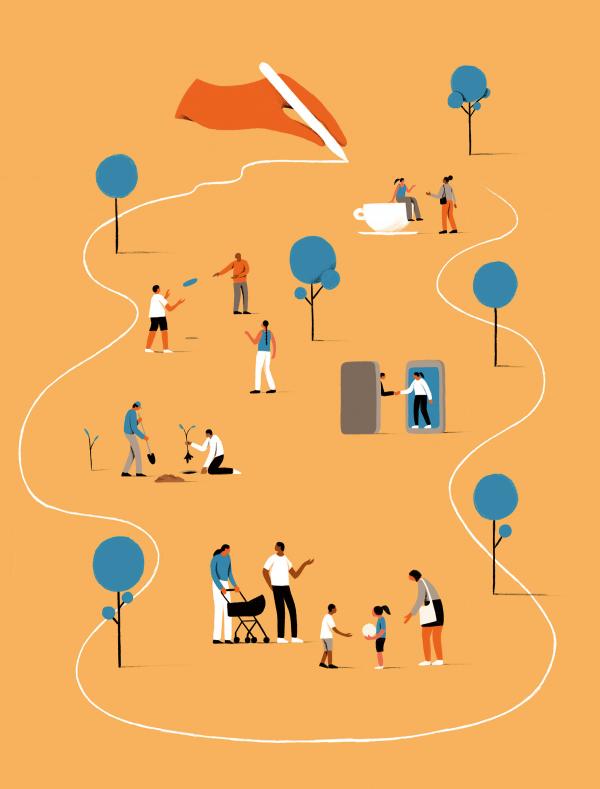
The problem was that Hunter and her other friends in Rotaract couldn’t find a club that fit their lifestyles. Hunter gathered the group in her home in Maidenhead, about 30 miles west of London, to compile a list of reasons that none of them, despite their enthusiasm for Rotary, had yet joined a Rotary club. It was a familiar litany: high costs, inconvenient meeting times, unreasonable demands on young professionals with new careers and families. “This clearly showed there were issues that had to be addressed,” says Hunter. “So we talked about what we would want from Rotary — and the Rotary Club of Maidenhead Bridge came to be.”
The eight-year-old club meets twice a month on Sundays in a local coffee shop. “This fits in with the style of our club,” Hunter says. “It’s relaxed and open to all, plus caffeine is needed on a Sunday morning. The meetings themselves are very informal: no toasts, no grace, not even a roll call. And you won’t see any jackets and ties.” Children are welcome, including Hunter’s nine-year-old daughter, who has attended every club meeting and event.
“Our club is very hands-on,” Hunter says. “We focus on community needs and how we can roll up our sleeves to help. We are keen to be seen doing things, showing Rotarians in action and shouting about it at the same time. This fits in with the fact that our members do not have large amounts of disposable income. It’s much easier to donate our time rather than hand over cash.”
The club has nearly 50 members and continues to grow. “We attract members via our website and online marketing through Facebook, Twitter, Meetup.com, and Instagram,” Hunter says. “Our posts are engaging and motivating, and, most importantly, they show our club in action.” Members also work to establish and maintain relationships with local leaders in government and business. “They help us to promote our events and give us access to resources. We have proved ourselves as reliable and professional event organizers, and now we find those local leaders coming to our club and asking us to help them, which is wonderful.”
The club’s first project, an Easter Family Fun Day in 2012, attracted 250 people and has become its signature annual event. The residents of Maidenhead appreciate that it is a free children’s activity that promotes healthy lifestyles, Hunter says. “It’s also a great event for the children of our members to help out at and put their ideas into play.”
The club sets an annual goal of providing 1,700 hours of volunteer work — though last year, it surpassed the 2,400-hour mark. Among other things, it works with a local food bank, helping collect food donations each week. It has also boosted the profile of the food bank and other local charities through a program called (no kidding) Pimp My Community. “It’s a great hands-on project that our members are passionate about,” says Hunter. Members donate their time and expertise to help these organizations improve their branding, marketing, events, and websites, thereby elevating their impact.
“We’ve enjoyed pushing the boundaries of Rotary, changing opinions on what people think Rotary is and what a ‘normal’ Rotarian looks like,” Hunter says. “I hope that other clubs consider sponsoring the formation of new Rotary clubs to attract younger people. And I want to see former Rotaractors take the lead to form new clubs. Be persistent and create change. Rotary really can be whatever you want it to be.”
Chartered in Addis Ababa in 2004, the Rotaract Club of Abugida indirectly derives its name from Ge‘ez, the classical language of Ethiopia, which includes the four characters ’ä, bu, gi, da. That may explain why the club, after 16 years, has so thoroughly mastered the ABCs of sustaining a healthy and productive club.

The club’s vigor springs in part from its blood drives, which began the same year Abugida was chartered. Recognizing a high demand for blood and a limited number of donors, club members turned to the Ethiopian Red Cross Society, with whom they formed what member Dawit Solomon calls a “collaborative network.” The initial blood drive attracted about 30 donors, mainly “fellow Abugidans and the Rotaract family at large.” Today the quarterly blood drives attract more than 500 donors — which has prompted the Red Cross to expand the event to two days.
“Our impact, although small at the beginning, started a powerful movement within our community,” Solomon says. “The club’s initiative has motivated other groups and local celebrities to take part in the drive” — and the impulse has spread to other Ethiopian Rotaract clubs, who work on blood drives in conjunction with the Abugida Rotaractors. (The spring 2020 blood drive was canceled over concerns about the COVID-19 pandemic, but the club encouraged donations to Ethiopia’s National Blood Bank.)
“Our club helped a great deal in meeting Ethiopia’s need for blood,” Solomon says. The project has also infused a vitality into the Abugida club, helping it attract new members and retain current ones — the alpha and omega of ensuring Rotary’s future.
Judith Neal has proven that to be a Rotarian, you don’t necessarily need to follow the laws of time and space: The 2019-20 president of the Rotary E-Club of Southern Scotland lives in Oconomowoc, Wisconsin. Neal comes from a family of dedicated Rotarians. In 1982, she was awarded a Rotary Ambassadorial Scholarship. Newly married, she and her husband, Richard, traveled from the United States to the United Kingdom, where Judith studied at the University of Bristol. Years later, the couple spent time in Botswana and in Scotland while Richard, a mathematics professor, was on sabbatical.
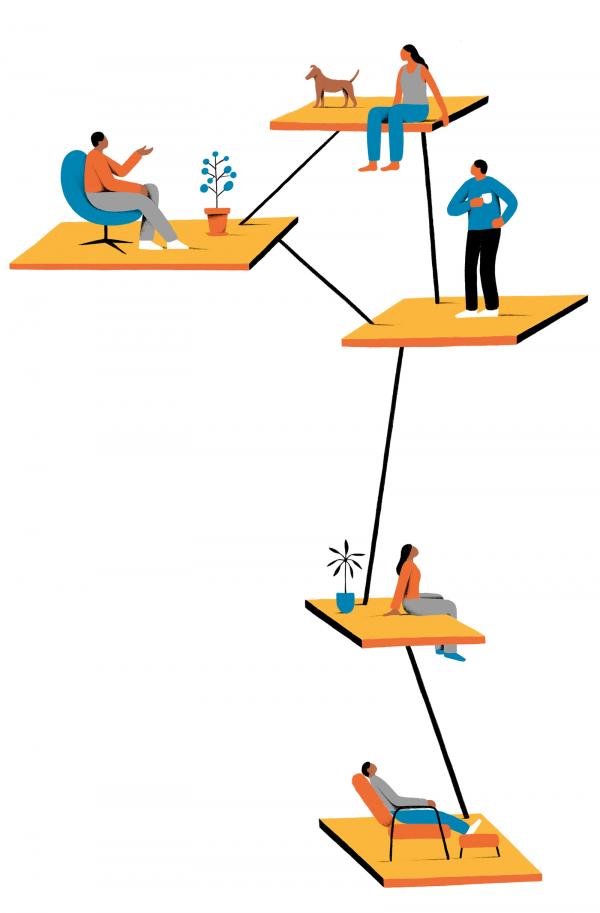
In all those places, Neal attended Rotary club meetings. “I met people from all over the world, some of whom are now good friends,” she says. But one club in Scotland, she says, was much more traditional than most she had visited, with most members men over the age of 60. “It wasn’t my cup of tea,” she recalls.
One rainy day in Scotland, Neal met a woman who was walking her dog. The two got to talking, and Lynne Nelson told Neal about the E-Club of Southern Scotland. “The more she told me about it, the more it seemed like it would be a good fit.”
Originally chartered in 2010 as the Rotary Club of Edinburgh Park, the club had changed to an e-club model in 2014 as its members began to disperse to London, Singapore, and other parts of the world. “My husband and I travel quite a bit, and as long as we have an internet connection, I can always attend a meeting,” Neal says. “But the greatest appeal is the international aspect of our club. Our far-flung members communicate by email and video chat, and we try to get together once a year, usually in Scotland” — where she is still friends with Nelson, the woman with the little dog who, on a rainy day, introduced her to Rotary’s ability to transcend space and time.